Nigel Gray
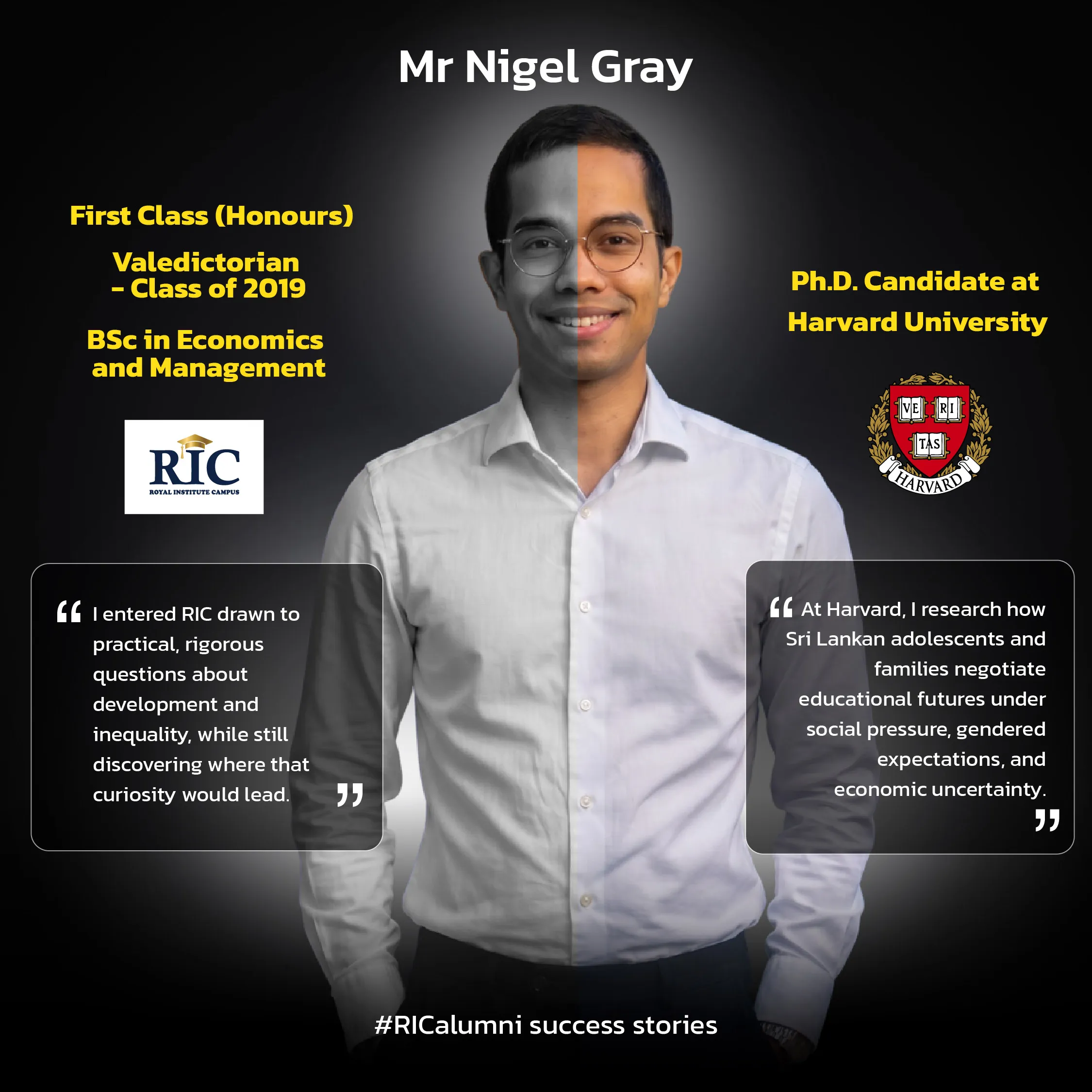
Programme: EMFSS
Year of Registration: 2016
Year of Convocation: 2020
Designation: PhD Candidate, Harvard University
1. If we were to rewind to your RIC days, who was Nigel then? What dreams, uncertainties or ambitions did you carry at the time?
I came into RIC being deeply driven, but also still trying to understand where that drive would take me. I wanted to do well academically and make the most of the opportunities my education could give me. Economics and Management was appealing because it felt practical, rigorous, and connected to real-world problems. At the same time, I was beginning to ask bigger questions about what kind of work would feel worthwhile to me, and how I could eventually use what I was learning to contribute to the communities I cared about.
2. Looking back, was there a moment, mentor, classroom conversation, or personal experience that quietly changed the direction of your life?
I do not think there was one single moment that changed my direction. It was more a series of experiences and conversations that slowly pushed me to think differently. One of the biggest lessons I have learned, especially at Harvard, is the importance of putting yourself out there. When people get to know you better – in terms of what you study, what you care about, and what questions you are trying to answer – you are more likely to be pointed toward others working on the same problems, as well as opportunities to further those interests which you would not have found on your own. I have also learned that growth does not only come from surrounding yourself with like-minded people. It also comes from engaging with people who see the world differently, because they often push your thinking the most.
3. Many students feel pressure to have life figured out early. Did your own academic and career paths unfold exactly as planned, or did uncertainty play a role?
My path did not unfold exactly as planned. Uncertainty played a very large role, and in a good way. I began in Economics, worked in policy research, taught for a while, and only later moved toward Education and Human Development. At each stage, I learned something important, even when the next step was not obvious. Looking back, I do not think uncertainty was a failure of planning. Rather, it was an iterative process of discovering which questions mattered most to me.
4. You transitioned from Economics and Management into Education and Human Development. What inspired that shift, and what questions were you trying to answer?
I first chose Economics and Management because, at the time, it felt practical and connected to real-world problems. I was interested in understanding how societies develop and why inequalities persist, but I did not yet know where that interest would lead. After graduating, my work at Verité Research exposed me to policy questions around socioeconomic inequality, education, and public institutions. That led me to pursue a master’s degree, where I hoped to better understand the relationship between education and economic opportunity. At Harvard, I encountered a different kind of learning. Much of what I had grown up with placed value on mastering content and performing well in structured assessments. In the U.S., many assignments gave me more space to pause, reflect, and connect course concepts to educational problems that felt personally and socially important to me. That contrast made me curious about how educational cultures shape the kinds of futures young people feel encouraged to pursue. More specifically, it pushed me toward Human Development because I wanted to understand how adolescents and parents negotiate educational choices together: how families express care through hopes for stability, how young people develop confidence and purpose, and how both can have better conversations about meaningful futures.
5. Your research explores how social pressures influence educational choices. Why does this topic feel personally or socially important to you? How can students balance expectations with personal purpose?
This topic matters to me because educational choices are rarely just individual choices. In Sri Lanka and many other contexts, young people often make decisions while carrying the hopes of their families and the weight of economic uncertainty. These pressures are not always harmful. In many cases, they come from care, sacrifice, and a desire for stability. But they can also narrow a young person’s sense of what is possible or push them toward paths that look secure from the outside but feel disconnected from who they are. My research tries to better understand how young people make sense of these pressures, how they shape their confidence and sense of purpose, and what this means for their well-being over time. I think young people should pause and ask where their ambitions are coming from. Is this path meaningful to me? Does it fit my strengths and values? Am I choosing from possibility, or mainly from pressure? My longer-term hope is that this work can help families, schools, and communities have more honest conversations about education and career choices. The goal is not to tell students to ignore their families, but to create conditions where young people can discuss which, paths feel personally meaningful and how those paths can still lead to secure and purposeful futures.
6. Harvard is often viewed as the dream destination, but what is something people misunderstand about studying at institutions like Harvard?
One misconception is that institutions like Harvard possess a special kind of knowledge that cannot be found elsewhere. I do not fully agree with that. The theories and methods we learn are often available across many universities. What Harvard has given me, however, is the confidence to ask difficult questions, speak with clarity, and imagine that I can contribute to change. That confidence is built through assignments that ask you to tackle problems of practice you are deeply driven to solve, the expectations placed on students, and conversations with professors who take your ideas seriously.
7. What advice would you give students hoping to pursue opportunities internationally while staying connected to their roots?
I would tell them not to see being an international student and staying true to their local roots as competing goals. Studying abroad can expand your thinking, but it should not require you to distance yourself from where you come from. In fact, some of my strongest insights in the U.S. have come from leaning into my Sri Lankan experiences and local knowledge. Much of what is taught in universities is shaped by Western contexts. Students from the majority world therefore have an important role to play not only learning these theories, but also asking what they miss and how their assumptions can be rethought for our own local contexts.