Dr Mithushi Wickramasinghe
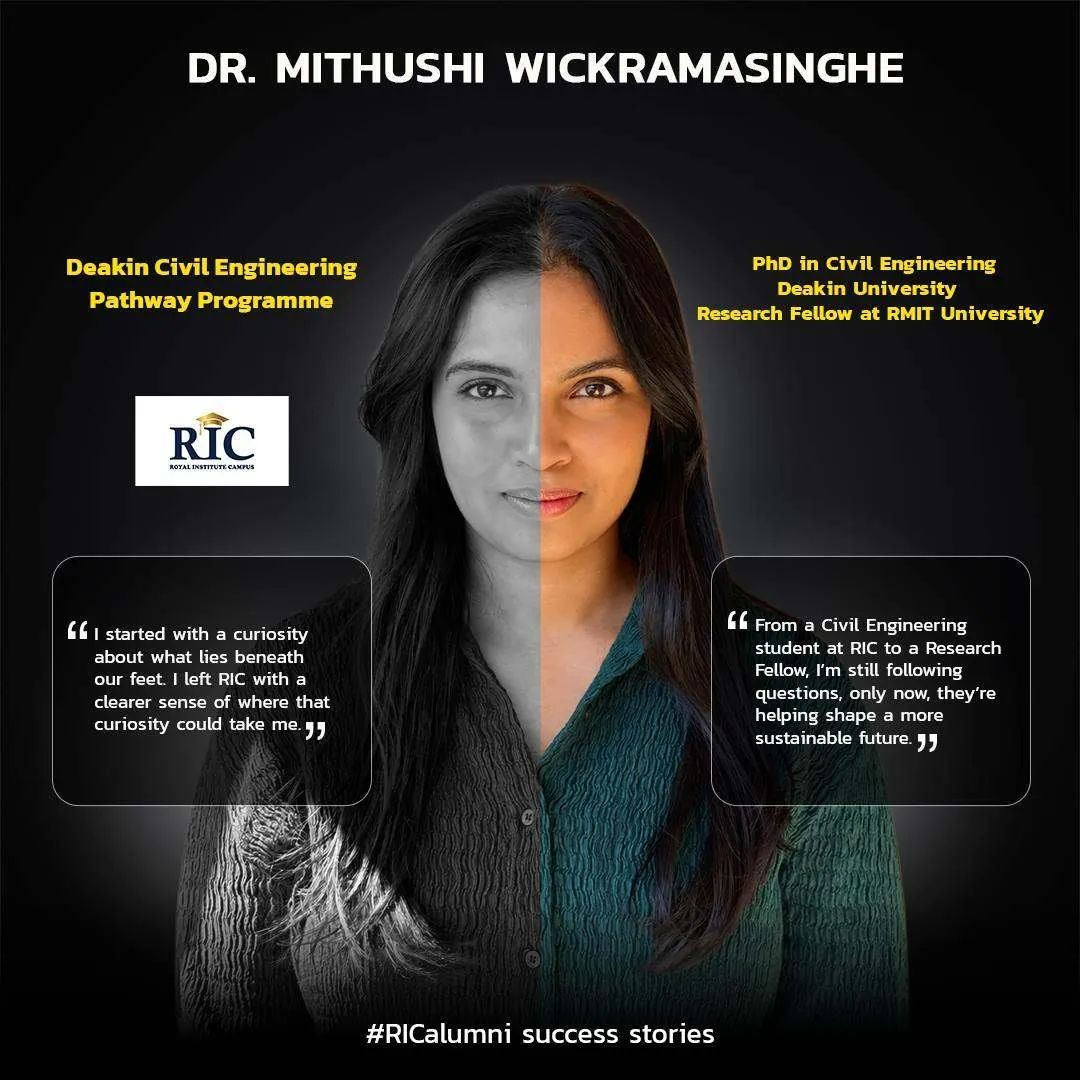
Programme: Bachelor of Civil Engineering (Honours)
Year of Registration: 2017
Year of Convocation: BCivEng (2021); PhD (2026)
Current Designation: Postdoctoral Research Fellow, RMIT University
Some journeys are carefully mapped from the very beginning. Others unfold quietly, until we look back and realise that every step was leading us somewhere meaningful.
In September 2017, I began studying Civil Engineering at Royal Institute Campus.
I had always been curious about how things are built. How does an idea become a structure? What makes something strong enough to withstand the forces around it? And what happens beneath the surface that allows everything above it to stand?
I had plenty of questions.
I just didn’t know yet where those questions would take me.
I chose RIC because the two-plus-two pathway offered me a practical route to an international degree. I could complete my first two years in Sri Lanka before transferring to Australia, making the journey both financially realistic and academically valuable.
Those first two years introduced me to almost every corner of Civil Engineering, from structural engineering and infrastructure to fluid mechanics and geotechnical engineering.
But one subject stayed with me.
Geotechnical Engineering.
There was something fascinating about studying what you couldn’t see.
A real difference was made through a practical approach to the subject.
Suddenly, engineering wasn’t just equations in a textbook. It was about understanding the earth beneath us, interpreting real problems, and figuring out how what happens underground can determine what happens above it.
I became curious.
Then I became fascinated.
And eventually, I realised I had found the area of engineering I wanted to explore further.
Sometimes, finding your path isn’t about having all the answers.
Sometimes, it’s about finding the right question.
In 2019, I moved to Australia to complete my Bachelor of Civil Engineering at Deakin University, Waurn Ponds.
Starting university in another country could have felt like starting from scratch.
But it didn’t.
The academic foundation I had developed during my time at RIC aligned closely with Deakin’s curriculum and standards. The learning environment and expectations were already familiar, which gave me something incredibly valuable when I arrived in a new country:
I could spend less time worrying about whether I belonged and more time thinking about where I wanted to go.
And by then, I knew that geotechnical engineering was more than just another subject for me.
It was becoming my direction.
After completing my Bachelor’s degree, I had a choice.
I could enter the profession.
Or I could keep asking questions.
I chose the questions.
In 2022, I received a full scholarship to pursue a PhD in Geotechnical Engineering at Deakin University.
A PhD is a different kind of journey. There are no neat answers at the end of every chapter. There are experiments that don’t work, ideas that need to be reconsidered, and days when progress feels almost invisible.
But there is something incredibly rewarding about being able to explore a question that genuinely matters to you.
Over the course of my PhD, I published three journal papers and two conference papers, gradually moving from being someone who studied engineering to someone who was contributing to the knowledge within it.
In 2026, I completed my PhD.
Today, I’m a Research Fellow at RMIT University, and my questions have evolved once again.
My research now focuses on sustainable construction materials, particularly the development of low-carbon concrete.
Concrete has helped shape the modern world. But building the future also means thinking carefully about the environmental cost of the materials we use to create it.
So now, my work revolves around a question that feels bigger than engineering alone:
How do we continue to build the world without compromising the world we’re building it in?
I don’t have all the answers.
But that’s what makes research exciting.
There is always another question waiting.
When I look back at the student who walked into RIC in 2017, I couldn’t have predicted where that first step would lead.
I didn’t know I would study in Australia.
I didn’t know I would pursue a PhD.
I certainly didn’t know I would one day be working on low-carbon construction materials.
But perhaps we don’t need to know all of that at the beginning.
Sometimes, all we need is a place to begin, people who help us recognise what we’re capable of, and the courage to follow a curiosity when it turns into something more.
Start where you are.
Follow what makes you curious.
Stay open to where it might lead.
You don’t have to see the entire staircase to take the first step. You just have to believe that there is somewhere worth climbing towards.
