Divyana Ranaweera
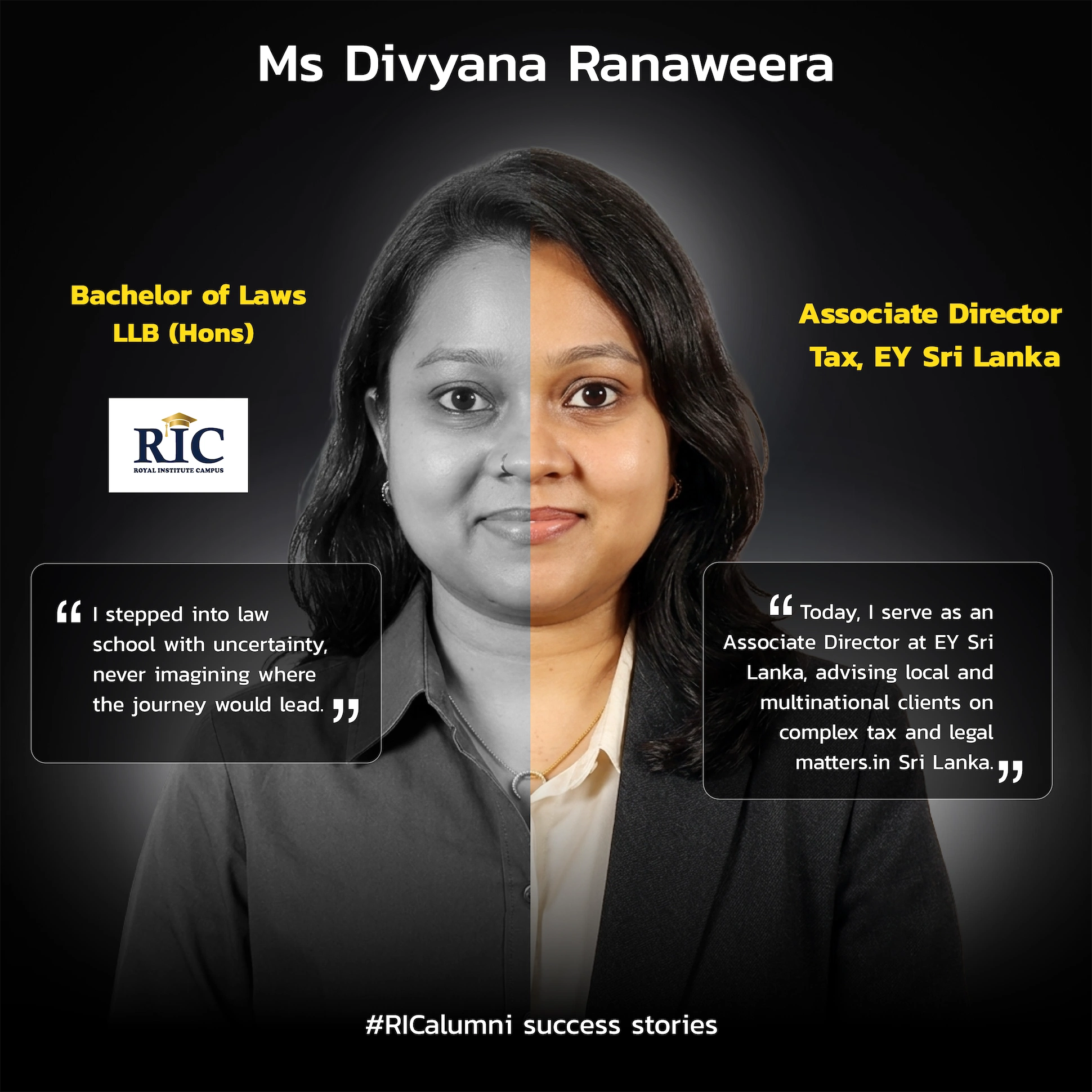
LLB (Hons) (University of London), LLM (University of Colombo), Attorney-at-Law
Programme: LLB
Year of Registration: 2013
Year of Convocation: 2017
Designation: Associate Director – Tax, EY Sri Lanka
When I first joined Royal Institute Campus in 2013, I genuinely had no idea what I was getting myself into. In fact, I still remember sitting in class on one of the very first days and not knowing the answer to a simple question: “What is a constitution?” Looking back now, it is funny to think about, considering how much of my professional life revolves around interpreting legislation, analysing legal principles, and advising clients on complex tax issues.
The truth is, law was never part of my plan. Growing up, I hoped to become a doctor. I enrolled in the law programme largely because my parents encouraged me to do so, and if I’m being completely honest, part of me thought I might eventually drop out and pursue something else. Fortunately, that never happened.
One of the biggest reasons I stayed was the support system at RIC. What stood out to me immediately was that the programme was entirely self-sufficient. Unlike the tuition culture that exists around many professional and academic qualifications, I never felt that I needed external classes or additional support to understand the subjects. The lectures, notes, and guidance provided by the lecturers were more than enough. If you attended lectures, engaged with the material, and worked through the notes provided, you had everything you needed to succeed.
The lecturers played a huge role in that experience. They were always approachable, encouraging, and willing to help students who were struggling. One lecturer who had a particularly significant impact on me was Mr. F.M.A. Ranaweera. To this day, he remains the best lecturer I have ever studied under. I still keep in touch with him even now. What amazed me most was his ability to teach entire topics seemingly from memory, often explaining concepts and narrating material without referring to notes. As a student, you couldn’t help but admire that level of knowledge and passion for teaching.
What I appreciated most about RIC was that it took someone who knew very little about law and gradually built the confidence and skills needed to understand and apply it. The environment was supportive rather than intimidating. Looking back, I realise that many of us probably achieved more than we thought we were capable of because the lecturers genuinely wanted us to succeed.
Beyond academics, some of my best memories come from the friendships I built during my time at RIC. The lunch outings, the games between classes, the conversations in the hallways, and simply spending time with friends are memories that I still look back on fondly today. Many of those friendships have lasted well beyond university and continue to be an important part of my life. RIC introduced me to a network of talented and accomplished people who have gone on to succeed in a wide range of professions, and I am fortunate to still call many of them friends.
Today, I work as an Associate Director in the Tax practice at EY Sri Lanka. My role involves advising local and multinational clients on complex tax matters, analysing legislation, reviewing case law, interpreting regulations, and helping clients navigate challenging commercial situations. Every day, I draw upon the analytical and critical thinking skills that I developed through my legal education.
When I think back to the student who could not answer what a constitution was on the first day of class, I am reminded of how far I have come and how important RIC was in that journey. It provided more than just an academic qualification; it provided the foundation, guidance, and confidence that helped shape my career.
To current students, my advice is simple: trust the process, make use of the support available to you, and don’t underestimate how much you can grow. You don’t need to know exactly where your career is going when you begin. I certainly didn’t. Sometimes all you need is the right environment, the right mentors, and the willingness to keep learning.
I am grateful to Royal Institute Campus for the role it played in my journey and proud to be part of the RIC community.